Matiru
"Trustable Food, Transparent Journey"
Matiru is a blockchain-powered agriculture supply chain platform that records every stage of the produce lifecycle - from the farmer to the consumer. It ensures transparency in pricing, quality, and origin, empowering all stakeholders and building consumer trust.
The Problem
The traditional agricultural supply chain is often plagued by:
- Opaque Pricing: Farmers lack visibility into final market prices, leading to exploitation by middlemen
- Unreliable Quality Checks: Manual and inconsistent certifications are susceptible to fraud and manipulation
- Lack of Consumer Trust: Claims like "Organic" or "Pesticide-Free" are difficult for consumers to verify independently
- Inefficiencies and Waste: Poor traceability makes it challenging to manage inventory, recall contaminated batches, and reduce spoilage
Core Features
- Farm-to-Fork Traceability: Every event in a produce's journey—from registration and transport to inspection and sale—is recorded on an immutable ledger
- Role-Based Dashboards: A tailored mobile app experience for each stakeholder:
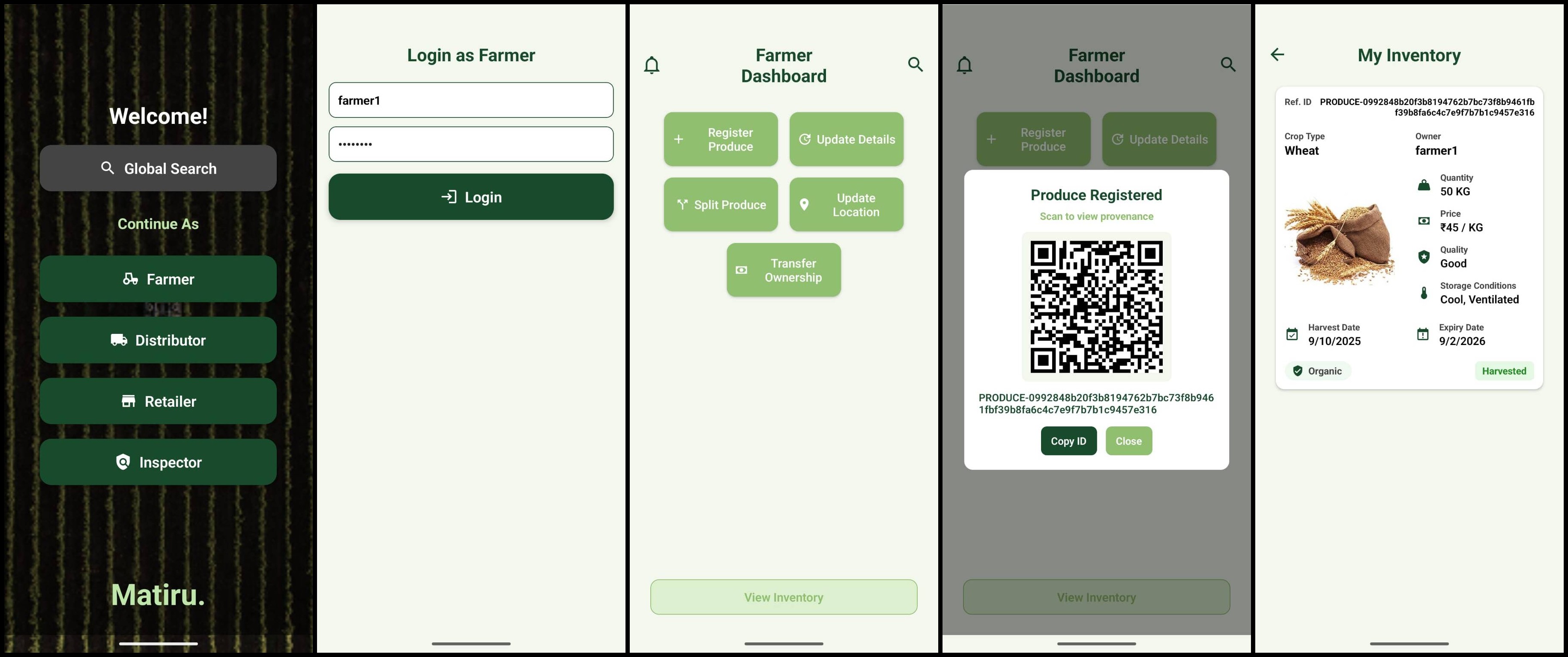
- Farmers: Register produce, generate QR codes, and transfer ownership
- Distributors: Update location, split batches, and manage resale
- Retailers: Confirm inventory and log final sales
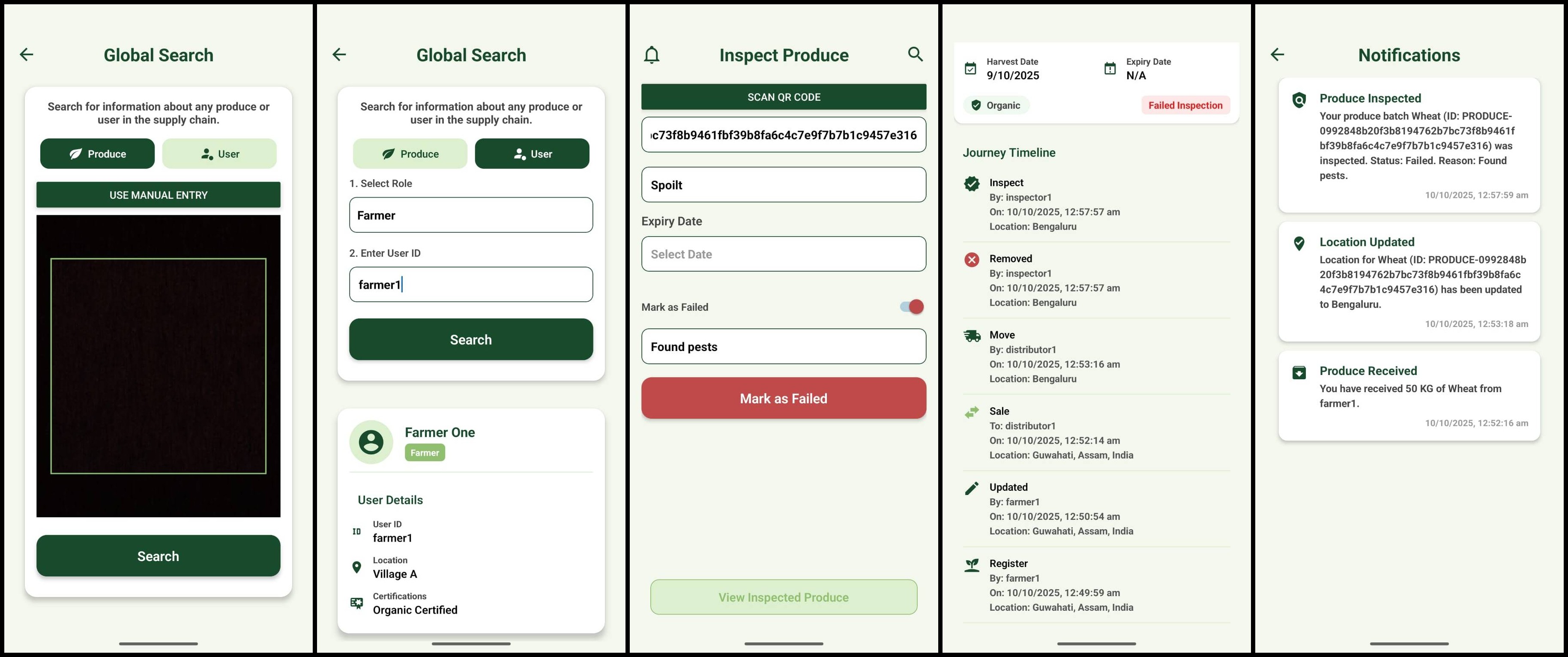
- Inspectors: Certify quality and record inspection results on-chain
- Immutable & Secure: Built on Hyperledger Fabric, all transactions are cryptographically secured and cannot be altered, preventing fraud
- Global Chain Access: A transparent ledger explorer allows authorized users to view all supply chain actions, fostering accountability
- QR Code Verification: Consumers can scan a simple QR code on the product packaging to view its entire history, ensuring authenticity and quality
Architecture
The system is composed of three main parts:
- Hyperledger Fabric Network: A private, permissioned blockchain where organizations (Farmers, Distributors, Retailers, Inspectors) run peers. A smart contract (
chaincode) governs all business logic, such as registering produce, transferring ownership, and performing inspections.
- NodeJS Backend: An API gateway that securely connects the mobile app to the blockchain network. It authenticates users and translates app requests into chaincode invocations.
- React Native Mobile App: A cross-platform application that provides a user-friendly interface for all stakeholders to interact with the supply chain. It includes offline support to ensure functionality in areas with poor connectivity.
Tech Stack
- Blockchain: Hyperledger Fabric
- Frontend: React Native (Expo)
- Backend: Node.js, Express
- Database: CouchDB (for World State)
Getting Started
To get a local copy up and running, follow these steps:
Prerequisites
- Docker & Docker Compose
- NodeJS &
npm
Installation
- Clone the repository:
git clone https://github.com/maydayv7/matiru
cd matiru
- Follow the detailed setup instructions in the INSTALL.md file to configure the blockchain network, start the server, and run the app
Preview
Screenshots of the application:
Documentation
For a more in-depth look at the project, read the following:
- SOLUTION.md: Detailed overview of the project
- MODEL.md: Description of the data model and chaincode functions
License
Distributed under the MIT License
See LICENSE for more information
1# Matiru
2
3**"Trustable Food, Transparent Journey"**
4
5Matiru is a blockchain-powered agriculture supply chain platform that records every stage of the produce lifecycle - from the farmer to the consumer. It ensures transparency in pricing, quality, and origin, empowering all stakeholders and building consumer trust.
6
7## The Problem
8
9The traditional agricultural supply chain is often plagued by:
10
11- **Opaque Pricing:** Farmers lack visibility into final market prices, leading to exploitation by middlemen
12- **Unreliable Quality Checks:** Manual and inconsistent certifications are susceptible to fraud and manipulation
13- **Lack of Consumer Trust:** Claims like "Organic" or "Pesticide-Free" are difficult for consumers to verify independently
14- **Inefficiencies and Waste:** Poor traceability makes it challenging to manage inventory, recall contaminated batches, and reduce spoilage
15
16## Core Features
17
18- **Farm-to-Fork Traceability:** Every event in a produce's journey—from registration and transport to inspection and sale—is recorded on an immutable ledger
19- **Role-Based Dashboards:** A tailored mobile app experience for each stakeholder:
20 - **Farmers:** Register produce, generate QR codes, and transfer ownership
21 - **Distributors:** Update location, split batches, and manage resale
22 - **Retailers:** Confirm inventory and log final sales
23 - **Inspectors:** Certify quality and record inspection results on-chain
24- **Immutable & Secure:** Built on Hyperledger Fabric, all transactions are cryptographically secured and cannot be altered, preventing fraud
25- **Global Chain Access:** A transparent ledger explorer allows authorized users to view all supply chain actions, fostering accountability
26- **QR Code Verification:** Consumers can scan a simple QR code on the product packaging to view its entire history, ensuring authenticity and quality
27
28## Architecture
29
30The system is composed of three main parts:
31
321. **Hyperledger Fabric Network:** A private, permissioned blockchain where organizations (Farmers, Distributors, Retailers, Inspectors) run peers. A smart contract (`chaincode`) governs all business logic, such as registering produce, transferring ownership, and performing inspections.
332. **NodeJS Backend:** An API gateway that securely connects the mobile app to the blockchain network. It authenticates users and translates app requests into chaincode invocations.
343. **React Native Mobile App:** A cross-platform application that provides a user-friendly interface for all stakeholders to interact with the supply chain. It includes offline support to ensure functionality in areas with poor connectivity.
35
36## Tech Stack
37
38- **Blockchain:** Hyperledger Fabric
39- **Frontend:** React Native (Expo)
40- **Backend:** Node.js, Express
41- **Database:** CouchDB (for World State)
42
43## Getting Started
44
45To get a local copy up and running, follow these steps:
46
47### Prerequisites
48
49- Docker & Docker Compose
50- NodeJS & `npm`
51
52### Installation
53
541. Clone the repository:
55 ```sh
56 git clone https://github.com/maydayv7/matiru
57 cd matiru
58 ```
592. Follow the detailed setup instructions in the **[INSTALL.md](./docs/INSTALL.md)** file to configure the blockchain network, start the server, and run the app
60
61## Preview
62
63Screenshots of the application:
64
65
66
67
68## Documentation
69
70For a more in-depth look at the project, read the following:
71
72- [SOLUTION.md](./docs/SOLUTION.md): Detailed overview of the project
73- [MODEL.md](./docs/MODEL.md): Description of the data model and chaincode functions
74
75## License
76
77Distributed under the MIT License
78See [`LICENSE`](./LICENSE) for more information